
Inflatables
New Operator Starter Fleet: The First 5 Units to Buy
Most new operators build their starter fleet backwards. They buy whatever unit is on sale, or whatever looked good in a supplier catalog, and only find out six months later that they own three units that all compete for the same Saturday birthday party booking. Meanwhile they're turning away corporate events, school field days, and off-season rentals because nothing in the fleet fits.
A starter fleet isn't about picking five good products. It's about picking five units that don't overlap — each one opens a different type of booking. Get that composition logic right and your first five units cover the majority of what actually comes through your phone in year one. Get it wrong and you'll be reinvesting in unit six, seven, and eight just to plug gaps you could have avoided from day one.
Why "buy 5 bounce houses" is the wrong instinct
If your entire starter fleet is five standard bounce houses, you've built a business that can only serve one event type: the backyard birthday party with a flat, open yard and no space constraints. Every unit competes with every other unit for the same booking window, and when two customers call for the same Saturday, you can only serve one.
The fix isn't buying more of the same thing — it's diversifying by function, not just by theme or color. Each unit in a well-built starter fleet should answer a different question a customer is asking: How big is my yard? How old are my kids? Is this a school event or a backyard party? Do I need something for July when everyone already owns a bounce house?
The 5-unit composition logic
This is the framework, not a shopping list of specific SKUs. Think of it as five roles your fleet needs filled, in priority order.
1. One standard bounce house — your volume anchor
This is the unit that books most often and pays for itself fastest, because it fits the broadest range of yards and ages. It's your default recommendation when a customer calls without strong preferences. Every rental fleet needs at least one inflatable bouncer as the foundation — it's the workhorse that generates the steadiest cash flow while your other units are still finding their audience.
2. One combo unit — your upsell and differentiator
A combo (bounce plus slide, or bounce plus climbing feature) commands a higher rental rate than a standard bouncer and gives you something to upsell customers who are comparing you against a competitor with only basic units. It also covers a slightly older age range and longer attention spans, which widens your booking window beyond toddler parties. A bounce house combo is usually the second unit operators add, and for good reason — it's the highest-margin piece in a starter fleet relative to its footprint.
3. One smaller-footprint unit — your access unit
Not every customer has a big flat backyard. Townhome patios, indoor venues, small church halls, and daycare play areas all need something compact. If your fleet only has full-size units, you're rejecting every booking that comes from a space-constrained venue — and there are more of those than new operators expect, especially in dense suburbs and urban markets. A smaller unit also rents cheaper, which makes it your entry-price offer for budget-conscious customers who'd otherwise book nothing at all.
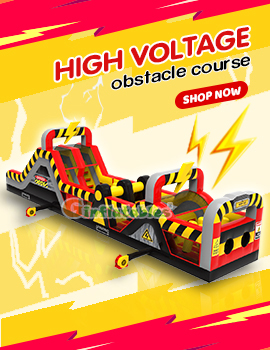
4. One obstacle course or interactive game — your corporate and school angle
This is the unit that gets you out of the backyard-party-only rut. Schools booking field day, companies booking a team-building afternoon, and churches booking a fall festival are not looking for a bounce house — they're looking for something with a competitive or team element. An obstacle course opens an entirely separate booking channel with less seasonal dependence than residential birthday traffic, and it tends to book in bulk (multi-unit school events) rather than one at a time.
5. One seasonal or differentiated unit — your off-peak and competitive edge
The fifth unit is where you diversify against the calendar or against your local competition. If you're in a hot-summer market, that might mean a water unit that fills your slowest indoor-party months with peak outdoor demand. If every competitor in your area already owns the same three generic units, it might mean something thematically distinct that gets requested by name. The point of unit five isn't volume — it's filling the gap your first four units leave open, whichever gap is most relevant to your specific market and climate.
Coverage scenario analysis: why this combination works
Run this fleet against the booking types that actually come in during a typical first year, and the logic becomes obvious:
- Standard backyard birthday party — covered by the standard bouncer, with the combo as an upsell and the small unit as a budget option.
- Small yard or indoor venue — covered by the small-footprint unit, which the standard and combo units physically can't serve.
- School field day / corporate team event — covered by the obstacle course, a booking type the other four units can't compete for.
- Repeat customer wanting something different next time — covered by having five distinct units instead of five copies of one, which directly improves repeat-booking rate.
- Off-peak or seasonal demand — covered by the fifth unit's specific role, whether that's water-based, holiday-themed, or otherwise differentiated from the rest of the fleet.
Five units, five different reasons someone picks up the phone. That's the test: if two of your units answer the same customer question, you don't have a five-unit fleet — you have a two-unit fleet with three redundant copies.
Budget tiering: thinking in relative terms, not dollar amounts
New operators often ask which tier to buy in for a starter fleet — entry-level or mid-tier commercial-grade. The honest answer depends on how much rental volume you're already lined up versus how much you're still building.
Entry-tier thinking makes sense if you're testing demand in a new market, running the business part-time initially, or have limited storage and transport capacity. Entry-tier units get you into the market faster and let you validate demand before committing more capital, but expect a shorter usable lifespan under frequent commercial use and budget for earlier replacement.
Mid-tier commercial-grade thinking makes sense if you already have bookings lined up, plan to run units multiple times per week, or are building toward a full-time operation from day one. The heavier-duty material and reinforced seams cost more upfront but reduce the repair and downtime costs that eat into margin when a unit is out for service during peak season — a real risk covered in more detail in this fleet repair kit and blower maintenance playbook.
A practical approach many operators use: buy the standard bouncer and combo unit (units 1 and 2, your highest-frequency earners) in mid-tier commercial grade since they'll see the most cycles, then buy the smaller unit, obstacle course, and seasonal unit in whichever tier your budget allows — upgrading them once volume justifies it.
How to estimate your own payback period
Don't rely on a generic "pays for itself in X weeks" claim from a supplier — build your own number from your local market data. The logic is simple:
- Estimate bookings per season, not per year. Most residential inflatable rentals cluster into a spring-through-fall window with a slow winter, so project unit-by-unit seasonal usage rather than a flat annual average.
- Multiply expected bookings by your local rental rate for that unit type to get projected seasonal revenue per unit.
- Subtract recurring costs — cleaning, minor repairs, insurance allocation, storage, and delivery fuel — to get net contribution per unit, not gross revenue.
- Divide the unit's total cost (equipment plus blower, stakes, and transport bag) by that net seasonal contribution to see how many seasons of use it takes to recover your investment.
Run this calculation separately for each of your five units, because they won't have the same payback timeline — your standard bouncer and combo will typically recover their cost faster than your seasonal or corporate-event unit simply because they book more often. That's fine. The seasonal and obstacle course units aren't there to be your fastest earners; they're there to widen the range of business you can say yes to, which is what turns a one-trick rental operation into a fleet that can grow.
For a broader look at getting a rental operation off the ground — licensing, insurance, and the operational basics that come before fleet-building — see this step-by-step guide to starting a bounce house rental business.
Building your first fleet? Our team can walk through commercial-grade options across each of these five roles and help you match unit specs to your local market and budget tier.
Talk to Our TeamWhatsApp