
Inflatables
Church Event Inflatables: VBS Week, Fall Festivals & Trunk-or-Treat Setups
Why Church Events Need a Different Inflatable Playbook
A church event runs on a different operating model from a rental company's Saturday birthday circuit. The equipment is set up by volunteers who have never inflated anything before, the age range spans toddlers to grandparents, and most of these events happen once a year — so nobody on the team has muscle memory from last time. The right purchase is rarely the most impressive unit on the quote sheet. It is the one your volunteers can actually run for six hours without a paid operator.
Three numbers decide most church equipment choices: how many volunteers will be on site, how long the event runs, and whether children are dropped off or stay with their parents. Answer those three and the shortlist builds itself. That is the whole framework behind sensible church event inflatables procurement: it is a staffing decision before it is a product decision.
The Three Scenarios and What Each One Actually Needs
VBS Week: Five Consecutive Days, Rotation Stations
Vacation Bible School is the one church event where durability matters more than novelty. A unit that survives five straight days gets inflated and deflated five times, handles several hundred children in total, and never gets a full day to dry out. Prioritise heat-welded seams, a blower rated for continuous running, and a repair kit on site — a budget unit that fails on Wednesday has no replacement in the storeroom.
The rotation-station format beats a single large attraction. Split the children into groups, give each group a twenty-minute slot at each station, and rotate on a whistle. Four small stations keep 120 children moving; one oversized bouncer creates a queue and a supervision problem at the same time. Water stations are the summer favourite, and they do not need a pool: a walk-through inflatable car wash tunnel handles a continuous line of children on a fraction of the footprint, drains itself, and dries in under an hour.
Fall Festival or Harvest Party: One Evening, Maximum Throughput
The October fall festival is usually the largest event on a church calendar outside Christmas, and it carries the widest age range because whole families attend together. That argues for zoning rather than one headline attraction: a toddler area with low-profile units, a middle zone with game stations, and a competitive zone for older children and teenagers.
Seasonal décor does measurable work here. A fall harvest inflatable display gives the evening a photographable centrepiece, and the photos families share are what fill the same event next year. Budget for one strong visual anchor before you budget for a third game station.
Trunk-or-Treat: The Controlled Alternative to Trick-or-Treating
Trunk-or-Treat has become the default Halloween event for a large share of American churches because it solves a supervision problem: everything happens in one parking lot, with cars parked in a ring and children moving from trunk to trunk in direct line of sight of adults. The equipment constraints are different from a fall festival. You are working on asphalt with vehicle traffic, so nothing can be staked or anchored, and the walking lane has to stay clear.
Compact, self-contained units work best — one small game per cluster of cars rather than one large attraction in the middle of the lot. A single attendant can supervise a station when it sits inside a ring of parked cars, which is exactly the ratio a volunteer team can hold for two hours.
Matching Equipment to Volunteer Capacity
The most common mistake churches make is buying an attraction that needs more staff than the event can supply. Group your options by how many people it takes to run them safely, not by how they look in the catalogue.
- Self-contained inflatables — inflatable bouncers, obstacle courses, slides. One attendant per unit, plus a queue monitor once a line forms. This is the right category when volunteers are scarce, which is most of the time.
- Refereed competitive games — tug of war, relay games, foam-dart arenas. Higher engagement and much higher throughput per square metre, but each one needs a referee plus someone managing the queue or bracket. Pair them with a large volunteer team.
- Water play — always add a dedicated spotter who is not also running the station, and confirm your policy covers it before you book anything.
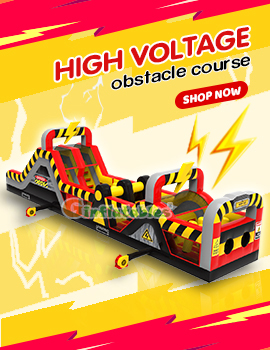
Our inflatable games range covers the first two categories, the obstacle courses line handles the throughput end of a rotation, and the inflatable water slides category covers VBS water days without needing a permanent pool.
Safety and Supervision With Volunteer Staff
Volunteer-run events need simpler rules, not fewer. A short written brief that every volunteer reads before the doors open does more for safety than any piece of equipment:
- Two-adult rule at every station, with no exceptions for short-handed moments.
- Posted capacity limits on every inflatable, enforced by the attendant rather than trusted to the children.
- Age zoning so toddlers and teenagers are never in the same unit at the same time, even when the rating technically allows it.
- A named first-aid point with a stocked kit and a charged phone, positioned where a volunteer can see the whole event area.
Check your liability cover before the event, not after. Most policies that cover church activities treat inflatables as a separate risk class, and some require the equipment to carry a recognised safety certification for public use.
Buy, Rent, or Share: The Procurement Decision
The working rule is simple: if the unit will be used three or more times a year, buying usually beats renting within two seasons, and the equipment is then available for youth group nights, community outreach, and the events nobody planned for. Below that threshold, renting keeps the storage problem and the maintenance problem with someone else.
Where storage is the blocker, two congregations sharing a unit is a common and workable arrangement — it splits both the purchase and the warehouse footprint. Settle the scheduling calendar and the damage-repair responsibility in writing first, because that is where shared equipment arrangements usually fail.
Booking Calendar: When to Lock In Your Dates
Church events cluster hard into a few weeks of the year, and so do the rental operators and manufacturers serving them. October events are typically booked in August and early September. VBS bookings run through the spring for a summer date. Custom-branded units — anything carrying your church name or logo — need roughly 30 to 60 days of production lead time on top of that.
If your fall festival date is already fixed, the practical deadline is now: confirm the equipment before the October rental calendar closes, and confirm the volunteers before you confirm the equipment.
The Real Decision
Church events reward equipment that is easy to run, hard to break, and good in photographs. Match the unit to your volunteer count first, add one strong visual anchor, and keep the rules short enough that a first-time volunteer can follow them on the day. Everything else is a detail you can adjust next year.
Ready to Equip Your Next Church Event?
Ginflatables builds commercial-grade inflatables for churches, schools and event operators — sized to the volunteer team you actually have.