
Inflatables
Bounce House Blower Guide: CFM Ratings, Sizing, and Maintenance for Rental Operators
Why the Blower Matters More Than You Think
A bounce house is only as reliable as the blower keeping it inflated. Operators who underprice their blower budget often find out why that was a mistake mid-event — a partially deflated unit with kids inside is a liability, not just an inconvenience.
The blower is a continuous-duty machine. Unlike a pump that fills a tank and shuts off, a bounce house blower runs the entire time the unit is in use — sometimes six to eight hours at a stretch. That means motor quality, CFM output, and thermal protection matter far more than the sticker price. A blower that fails on a Saturday afternoon during a peak-season event costs you that booking fee, your reputation, and potentially a replacement unit rental at full price.
For operators running a fleet of inflatable bouncers, getting the blower spec right for each unit is a non-negotiable part of the business. This guide walks through every variable you need to make the right call.
CFM and HP Explained: What the Specs Actually Mean
Two numbers dominate blower specs: CFM (cubic feet per minute) and HP (horsepower). They're related but not interchangeable, and misreading them is the most common purchasing mistake.
CFM measures airflow volume — how much air the blower can push per minute. This is the spec that determines whether your inflatable stays rigid under load. A unit with too little CFM will sag at the walls and roof when a few kids pile on, because the air leaking out through seams and the entrance tunnel exceeds what the blower can replace.
HP measures motor power — the electrical energy being converted to mechanical work. Higher HP generally produces higher CFM, but the relationship isn't linear because impeller design, duct diameter, and housing efficiency all affect actual output. A well-engineered 1 HP blower for a bounce house can outperform a poorly designed 1.5 HP unit.
For commercial inflatables, typical blower specs break down like this:
- 0.5 HP / ~300–400 CFM — undersized for most commercial units, occasionally used for small promotional displays
- 1 HP / ~500–600 CFM — appropriate for standard single-chamber bouncers up to roughly 13×13 ft
- 1.5 HP / ~750–900 CFM — suitable for mid-size combo units and larger bouncers up to 15×15 ft
- 2 HP / ~1000–1200 CFM — required for large combos, water slides, and obstacle courses
- 3 HP / 1500+ CFM — used for oversized units, dual-chamber setups, or units with high air loss (water features, large tunnels)
Blower units in commercial-grade ranges typically weigh between 8 and 22 lbs depending on HP. Lighter units are easier to transport but may sacrifice motor longevity under continuous load. Look for thermal overload protection as a standard feature — it automatically cuts power if the motor overheats rather than burning out the windings.
How to Match a Blower to Your Inflatable
The correct method for sizing a bounce house air blower is to start with the unit's volume and shape, then work backward to the CFM requirement. Manufacturers of commercial-grade inflatables typically specify the required blower in the product documentation — use that number as your floor, not your target.
As a practical field guide, here's a sizing table based on unit type and approximate volume:
| Unit Type | Footprint | Min. CFM | Recommended HP |
|---|---|---|---|
| Basic bouncer | 10×10 – 13×13 ft | 400–500 CFM | 1 HP |
| Standard bouncer | 13×13 – 15×15 ft | 550–700 CFM | 1–1.5 HP |
| Combo bounce/slide | 15×15 – 18×18 ft | 750–950 CFM | 1.5–2 HP |
| Large combo / water slide | 20+ ft length | 1000–1300 CFM | 2–3 HP |
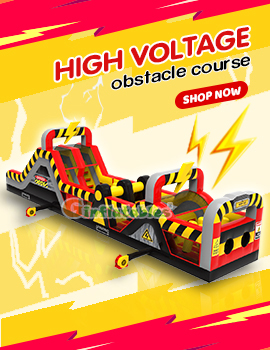
| Obstacle course | 40–60 ft runs | 1200–1800 CFM | 2×1.5 HP or 1×3 HP |
Units with open-top designs, large entry tunnels, or mesh panels lose more air than fully enclosed chambers and require CFM at the upper end of each range. Water slides with active water features also see higher air loss because moisture infiltrates the inflation column and added weight compresses air volume.
For operators running obstacle courses, pay particular attention to units with multiple chambers or long tunnel sections — these almost always require dual blower setups or a single high-CFM unit rated above 1500 CFM.
Single vs Dual Blower Setups
Most bouncers run on a single blower. Dual blower configurations are used when a unit has multiple sealed chambers, when total volume exceeds what a single motor can handle efficiently, or when the operator wants built-in redundancy.
Single blower — simpler setup, one power connection, easier to troubleshoot. Appropriate for the majority of standard and mid-size inflatables. If the blower fails, the unit goes down completely, so carrying a spare is standard practice for professional rental operators.
Dual blower — each blower feeds a separate chamber through its own inflation tube. This is common on large obstacle courses and combo units where chambers serve different functions (jumping area, slide, tunnel). If one blower fails, the other chamber may remain usable. Dual setups add complexity at setup — two power sources, two inflation tubes to manage, two motors to maintain.
Some operators use dual blowers on a single chamber as an oversizing strategy to ensure rigidity under maximum load. This works, but it also increases seam stress over time. Over-inflation through excessive airflow causes premature wear at stress points — particularly around anchor D-rings and entrance arch seams. Match output to spec rather than using brute force.
Blower Maintenance: Keeping Your Fleet Running
A jump house blower running at commercial frequency needs a defined maintenance schedule. Motors that run hot, accumulate debris in the intake, or vibrate on uneven surfaces fail faster. Here's a practical schedule:
After every event:
- Inspect the intake screen for grass, leaves, and debris — clear anything blocking airflow
- Check the power cord for cuts, kinks, or heat damage at the plug end
- Wipe down the housing — remove moisture from wet-weather events
Weekly (or every 10 events):
- Check the impeller for visible damage or wobble — any imbalance accelerates bearing wear
- Test thermal reset — run the blower for 30 minutes and confirm it doesn't trip unexpectedly
- Inspect the inflation tube collar and zipper/velcro seal on the unit for air leaks at the connection point
Monthly:
- Blow out interior motor housing with compressed air to remove dust accumulation
- Check capacitor condition if the motor is showing slow-start behavior — a failing start capacitor is a common cause of motor burnout
- Log blower hours and note any performance changes
For a complete maintenance checklist covering both blowers and inflatable fabric care, see the repair kit and blower maintenance guide.
Common Blower Problems and Quick Fixes
Most blower failures fall into a short list of categories. Knowing how to diagnose them in the field saves wasted time and incorrect replacement orders.
Unit inflates slowly or doesn't hold pressure — first rule out the unit itself before blaming the blower. Check all zipper closures and inflation tube connections. A partially open zipper on a large combo can drop effective pressure enough to look like blower failure. If the unit seals properly and pressure is still low, verify CFM output by timing inflation from flat to full — a 13×13 bouncer should reach full inflation in under 2 minutes with a correctly sized blower.
Blower motor won't start — check the thermal overload reset button (usually a red button on the motor housing). If the motor ran hot at the previous event and wasn't allowed to cool, it will trip on startup. Reset and allow 10 minutes before retrying. If it won't start after reset, suspect a failed start capacitor.
Motor hums but impeller doesn't spin — the impeller is seized or the capacitor has failed. Do not run a seized motor — it will burn the windings within seconds.
Excessive noise or vibration — debris in the impeller housing or a bent impeller blade. Clear debris and inspect for damage. A bent blade cannot be straightened reliably — replace the impeller or the unit.
Power cord failure at the plug — the most common field repair. Commercial blowers draw 8–15 amps at startup; cheap plug ends arc and burn. Replace with a heavy-duty replacement plug rated for the amperage. Never use household extension cords — run a 12-gauge minimum extension rated for outdoor use.
What to Look for When Buying a Replacement
When a blower reaches end of life or fails beyond field repair, replacement decisions should be made on commercial-grade criteria, not consumer specs. The bounce house blower market includes a wide range of quality tiers, and the cheapest units rarely hold up to six-day-a-week rental use.
Key specifications to verify before purchasing:
- Continuous-duty motor rating — must be rated for sustained operation, not intermittent use
- Thermal overload protection — automatic reset preferred over manual for field use
- Inlet diameter and tube compatibility — confirm it matches your inflatable's inflation port size (typically 8-inch, 10-inch, or 12-inch diameter)
- Cord length — commercial blowers should include a minimum 25-foot cord; shorter cords force the use of extension cords at every event
- Weight — heavier motors generally indicate more robust construction, but anything above 18 lbs starts adding transport friction for high-volume operators
Understanding material differences in the inflatables themselves also affects blower selection — heavier PVC units require more sustained pressure than lighter Oxford cloth builds. The PVC vs Oxford Cloth comparison covers how material weight affects operational requirements.
Replacement commercial bounce house blowers and compatible accessories are available through Ginflatables — matched to specific unit models to eliminate the guesswork on CFM and inlet sizing.
The core principle remains consistent across all unit sizes and configurations: match the blower to the unit's volume and air-loss characteristics, maintain it on a defined schedule, and carry a spare. Operators who treat blowers as an afterthought spend their peak-season weekends troubleshooting instead of delivering events.
Ready to Add This to Your Fleet?
Ginflatables builds commercial bounce houses and blowers to commercial-grade specs for rental operators and event businesses.
Get a QuoteWhatsApp