
Inflatables
Inflatable Maze Buyer's Guide: Layout, Throughput & ROI for Operators
Most attractions need a staffer running them. An inflatable maze doesn't. You unzip the entrance, a kid walks in, and they come out the other side two or three minutes later having done all the work themselves. One person standing at the exit can supervise a structure that's moving 200-plus people an hour. That ratio—high throughput, almost no labor—is exactly why mazes have quietly become one of the best margin attractions an FEC, school, or event operator can own.
Let's be clear up front about what this is, because the term gets muddled. A walk-through inflatable maze is a multi-path, self-navigated structure. You enter, you choose left or right at each junction, you find your way out. It is not a haunted maze (no theming, no scare actors, no darkness), and it is not a linear obstacle course where everyone runs the same single track. The whole point is choice and self-direction, and that's what makes it a different purchase.
Size, footprint, and how the path modules work
A commercial inflatable maze is built from inflatable walls—panel sections, usually 6-8 ft (1.8-2.4 m) tall—joined into a grid. Entry-level units run around 20 x 20 ft (6 x 6 m), which fits a small footprint and suits younger kids. Mid-size mazes land at roughly 30 x 30 ft (9 x 9 m), and the big crowd-pleaser units reach 40 x 40 ft (12 x 12 m) or larger, giving you a genuinely confusing path for older children and adults.
What separates a maze from a simple bouncer is the internal layout. The interior is a network of corridors with junctions, dead ends, and—on better units—pop-through windows, crawl panels, and short climb-over obstacles built into the path. That mix of decision points and physical challenges is what keeps a 40 ft maze interesting for more than one pass.
Reconfigurable panels: one structure, many layouts
The feature that earns a maze its keep is modularity. The interior walls attach with hook-and-loop or zip connections, so you can rearrange the corridors. In practice that means you reshape the maze to the audience: open up wide, simple paths with few dead ends for a preschool field day, then close it down into a tight, branching layout for a teen lock-in or a corporate team-building afternoon. The same physical unit serves a 5-year-old's birthday party and a 14-year-old's school carnival. That flexibility also lets you fit an awkward venue—shrink the footprint or change the aspect ratio to suit the floor you've actually got.
Capacity and per-hour throughput
Throughput is where the maze argument gets won. Because people are continuously entering and exiting—rather than waiting for a single rider to finish—a maze keeps a steady flow moving. A mid-size unit comfortably holds 8-15 navigators inside at once depending on age and layout, and with an average run time of two to three minutes you can realistically clear 150-250 people per hour through a single maze.
Compare that to a slide or a single-lane attraction that cycles one or two people at a time, and the math on a busy festival day is obvious. To push throughput even higher, look for a unit with multiple entrances. Feeding two entry points spreads the queue and prevents the bottleneck that kills your line at the front door. The faster the maze loads, the more wristbands or tickets it justifies.
Sightlines and supervision: keeping it self-service
A maze only runs itself if your staffer can actually see what's happening inside. This is the spec buyers most often overlook. Good commercial mazes use mesh-window walls and open skylights—the top is left open or netted so an adult standing outside, or a spotter on a step platform, can scan the whole interior. That visibility is what prevents a small child from getting genuinely stuck or panicking in a dead end, and it lets one person manage the structure without walking the corridors.
Set up your supervision flow so the watcher stands where the open top gives the widest view, with the exit in clear sight. Lower interior walls (6 ft rather than 8 ft) help adults see over the maze entirely. For mixed-age sessions, keep entry pacing reasonable—don't pack 20 toddlers in at once—and the self-service model holds up all day with a single attendant.
Indoor vs outdoor, and weather
Mazes work in both settings, but the install differs. Indoors, you're limited only by ceiling height and floor area—no wind concerns, so it's the easiest deployment for FECs and school gyms. Outdoors, the same rules as any inflatable apply: anchor with stakes on grass or sandbags/water barrels on hard ground, and shut down in sustained winds above the manufacturer's rated limit (typically around 15-25 mph). The large flat-walled surfaces of a maze catch wind, so anchoring matters more here than on a compact bouncer. Plan for shade or an early shutdown in extreme heat, since dark vinyl interiors warm up.
Building a play zone: combining maze with other modules
A maze rarely travels alone in a serious operation. It anchors well alongside other walk-in attractions, and because the throughput is so high it keeps the rest of your zone fed with happy, warmed-up kids. Operators frequently pair a maze with a climb or slide element, or drop it into a larger play setup. If you're building out a multi-attraction area, our range of inflatable funland play structures combines maze-style navigation with slides and climbs in a single footprint, and our writeup on multi-activity play zones for commercial venues walks through how to lay out a profitable mixed zone.
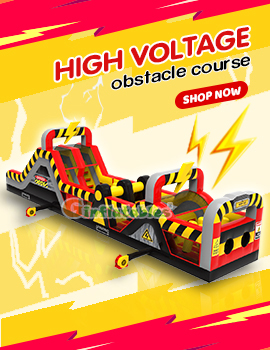
If your audience skews toward competitive, single-track racing rather than free navigation, that's a different product—an inflatable obstacle course unit gives you the linear run-and-climb format instead. We break down the formats in our blow-up obstacle course buyer's guide covering the four main types, which is worth a read before you decide between a maze and a course. For smaller add-ons that round out a zone—target games, interactive units, and lighter activities—our commercial inflatable games catalog covers the supporting pieces.
ROI: why the labor math wins
The return on a giant inflatable maze comes from two numbers working together: high throughput and near-zero labor. Most attractions are gated by how many staff you can afford to run them. A maze flips that—one attendant, 200 people an hour, all day. On the rental side, that same low-staff profile makes an inflatable maze rental easy to deliver: drop, anchor, supervise, collect. A unit that books steadily for weekend events and school field days pays for itself within a season or two and then runs as pure margin. Whether you're an FEC adding a permanent inflatable maze attraction or a rental company expanding your fleet, the self-service economics are the reason this category keeps growing.
Cleaning and maintenance
Maintenance is straightforward but non-negotiable for a high-traffic walk-through. Wipe down interior walls and the floor daily with a mild disinfectant—mazes see a lot of hand contact on those corridor panels. Inspect the seams and connection points where the modular walls join, since those take repeated stress from reconfiguring. Check the blower intake and keep it clear, dry the unit fully before rolling it to prevent mildew on the large vinyl surfaces, and store it loosely folded. Commercial-grade 18-20 oz PVC tarpaulin handles years of use if you keep it clean and dry; the panels are the wear point, so treat the connectors gently when you reshape the layout.
Ready to Add This to Your Fleet?
Ginflatables builds commercial-grade inflatables to spec for rental operators and event businesses.