
Inflatables
Indoor Inflatable Park: How to Plan, Equip, and Operate a Year-Round Venue
Why Indoor Inflatable Parks Are a Year-Round Revenue Play
Outdoor inflatable rental businesses shut down for rain, wind, and winter. Indoor inflatable parks don't. A properly equipped indoor inflatable park generates consistent foot traffic twelve months a year — birthday parties in January, school field trips in March, summer camp groups in July, and holiday events in December. Weather never cancels a session.
The economics are straightforward: a single outdoor rental unit might book 80–120 days per year in a favorable climate. An indoor venue with the same equipment operates 350+ days annually. That consistency makes revenue projections bankable, which matters when you're signing a commercial lease and financing a buildout.
But the gap between "great concept" and "profitable venue" is filled with details most first-time operators underestimate — ceiling clearances, HVAC capacity, insurance classifications, and equipment layout. Get those wrong, and you're burning cash on a warehouse that doesn't convert visitors into repeat customers.
Space and Facility Requirements
Ceiling Height, Square Footage, and Layout Zones
The single most common mistake in indoor inflatable park planning is signing a lease before measuring ceiling height. Most commercial inflatable bouncers need 18–22 feet of overhead clearance — that's the inflated height of the unit plus a minimum 3-foot safety buffer to the ceiling structure. Standard retail or office space at 10–12 feet won't work. You're looking at warehouse, big-box retail, or purpose-built industrial space.
For total floor area, plan on 8,000–15,000 square feet as a minimum viable venue. Here's how the space typically breaks down:
| Zone | % of Total Space | Sq Ft (10,000 sq ft venue) |
|---|---|---|
| Main arena (bounce + obstacles) | 45–50% | 4,500–5,000 |
| Interactive game zone | 15–20% | 1,500–2,000 |
| Toddler area | 10% | 1,000 |
| Party/event rooms | 10% | 1,000 |
| Lobby, restrooms, storage | 15–20% | 1,500–2,000 |
Leave 6–8 feet of clearance between inflatable units for safe traffic flow and staff access. Every unit also needs a dedicated blower placement zone — typically 3–4 feet behind the unit where the blower sits and exhausts air.
HVAC, Electrical, and Fire Code Considerations
Inflatable blowers generate significant heat. A single 2 HP blower produces roughly 6,800 BTU/hour, and a 10-unit venue might run 12–15 blowers simultaneously. That heat load stacks on top of body heat from 80–150 active children. Your HVAC system needs to handle 15–25 tons of cooling capacity for a 10,000 sq ft venue — far more than the building's existing system likely provides.
Electrical requirements are equally specific. Each commercial blower draws 11–15 amps on a 120V circuit. You'll need dedicated 20-amp circuits for every 1–2 blowers, plus separate circuits for lighting, HVAC, POS systems, and emergency equipment. Budget for a 400-amp electrical panel minimum. Many operators discover they need a panel upgrade only after signing the lease — get an electrician's assessment during due diligence.
Fire code is non-negotiable. Commercial inflatables in indoor venues must meet NFPA 701 flame-retardancy standards. Your jurisdiction will likely require sprinkler coverage over inflatable areas, illuminated exit signage visible from every zone, and fire extinguishers within 75 feet of any point in the facility. Get your local fire marshal involved early — their requirements will shape your layout.
Equipment Mix — What Goes in Each Zone
Main Arena (Bounce Houses and Obstacle Courses)
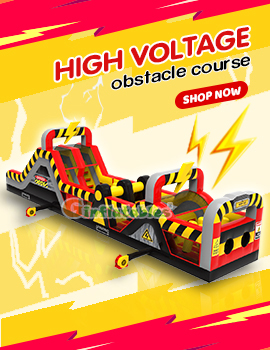
The main arena is your anchor — it's what people see in photos and what drives first visits. Stock it with a mix of open-play bounce houses and obstacle courses. Obstacle courses are particularly effective for indoor parks because they create natural traffic flow and keep kids moving through rather than clustering in one spot.
For a 5,000 sq ft main arena, a typical equipment mix includes 2–3 large bounce houses (each occupying 225–400 sq ft of floor space) and 1–2 obstacle courses running 40–60 feet in length. Obstacle courses deliver the best throughput — they can cycle 6–8 kids per run compared to 8–10 kids occupying a bounce house for extended free play.
Prioritize commercial-grade 18 oz PVC vinyl units rated for continuous use. Indoor units take more abuse than rental units because they run 8–10 hours daily instead of 4–6 hours per event. Reinforced stitching at stress points and heavy-duty D-ring anchoring are baseline requirements, not upgrades.
Interactive Game Zone
This is where you differentiate from competitors. Interactive games — IPS (Interactive Play Systems) panels, inflatable jousting arenas, basketball shootouts, and wrecking ball games — give older kids (8–14) and adults a reason to stay engaged. A venue with only bounce houses loses the 10+ age group fast.
Interactive units typically need 200–400 sq ft each and 14–18 feet of ceiling clearance. They also command higher per-session pricing because they feel like premium attractions rather than open play.
Toddler Area
A dedicated toddler zone (ages 1–4) is a revenue multiplier, not an afterthought. Parents with toddlers won't pay full admission if their child can't safely use the main equipment. A separated area with soft-play inflatable playground systems, mini slides, and ball pits — enclosed with inflatable walls or netting — converts that demographic into paying customers.
Keep toddler units under 6 feet in inflated height and ensure the area has direct sightlines from a parent seating section. This zone also drives weekday morning revenue when school-age kids aren't available.
Party and Event Rooms
Party rooms transform a single-admission business into a high-margin event venue. A 10,000 sq ft facility should have 2–3 party rooms at 200–300 sq ft each. These rooms generate premium revenue — birthday party packages typically yield 3–5x per-head versus general admission.
Keep party rooms adjacent to the main arena with visibility windows so kids can see the action. Include dedicated storage for party supplies and a direct path to restrooms. Some operators install indoor slides as dedicated party-room attractions to justify the premium pricing.
Outfitting an Indoor Park?
Share your floor plan and ceiling height — we'll recommend the right bounce house, obstacle course, and game mix to maximize your per-session revenue.
Get an Equipment Package Quote →WhatsAppRevenue Model and Pricing Structures
Most successful indoor inflatable parks run a hybrid model: general admission for walk-ins plus packaged pricing for parties and group events. General admission is typically sold in 1–2 hour session blocks, with capacity managed by session to avoid overcrowding and maintain safety ratios.
Revenue diversification matters more than maximizing any single stream:
- General admission sessions — your base revenue, 40–50% of total
- Birthday party packages — highest margin, 25–35% of total
- Group bookings (schools, camps, corporate) — fills weekday gaps, 10–15%
- Concessions and merchandise — grip socks, snacks, drinks, 5–10%
- Membership programs — monthly passes that guarantee recurring revenue and reduce acquisition cost
The grip sock requirement deserves a note: mandatory branded socks (sold at the door) serve double duty as a safety measure and a high-margin ancillary revenue line. Many parks report sock sales covering a meaningful portion of their staffing costs.
Safety, Staffing, and Insurance
Indoor inflatable parks are classified as amusement venues by most insurers, which means your general liability policy needs specific endorsements for inflatable equipment, participant injury, and premises liability. Every staff member needs training on:
- Capacity limits per unit (typically posted by the manufacturer)
- Age and size separation protocols
- Emergency deflation procedures
- Basic first aid and incident documentation
- Blower monitoring — a blower failure during operation requires immediate evacuation of that unit
Staffing ratios directly affect both safety and insurance premiums. Industry standard is one trained attendant per 2–3 inflatable units during peak hours, plus a minimum of one floor supervisor overseeing the entire venue. Digital waiver systems (signed at check-in kiosks) are now standard for streamlining entry and providing timestamped documentation.
Lease Negotiation and Buildout Timeline
Landlords unfamiliar with indoor entertainment venues will have questions about noise, insurance, foot traffic, and tenant improvements. Come prepared with a professional business plan that addresses these directly. Key lease terms to negotiate:
- Tenant improvement allowance — HVAC upgrades and electrical panel work can be substantial; negotiate the landlord covering base infrastructure
- Percentage rent caps — some commercial leases include revenue-based rent; cap it or avoid it
- Signage rights — visibility from the road is your primary marketing channel
- Exclusive use clause — prevent the landlord from leasing adjacent space to a competing play venue
- Early termination protection — your buildout investment is substantial; ensure the lease term justifies it
A realistic buildout timeline from signed lease to grand opening is 12–16 weeks. That includes 2–3 weeks for permits and inspections, 4–6 weeks for HVAC and electrical work, 2–3 weeks for flooring and safety padding, and 2–4 weeks for equipment delivery, inflation testing, and staff training. Equipment lead times from manufacturers are typically 3–5 weeks for standard commercial units — order as soon as your lease is executed, not after buildout starts.
The operators who succeed with indoor inflatable parks are the ones who treat it as a facilities engineering project first and a fun brand second. Get the infrastructure right, choose equipment that matches your space constraints, and build your revenue model around multiple streams. The fun part is easy — the building is the hard part.
Ready to Build Your Equipment List?
Send us your venue dimensions and target capacity. Our team will spec a complete equipment package — bouncers, obstacles, games, and toddler units — with layout recommendations.
Start Your Indoor Park Project →WhatsApp