
Inflatables
Commercial Inflatable Games for Sale: ROI Analysis for Rental Operators
Rental operators evaluating inflatable games for sale face a more complex ROI calculation than they do with bounce houses or slides. A bounce house is a relatively predictable unit — you know the footprint, the age group, the rental rate, and the maintenance baseline. Interactive games are a different class. A jousting arena, a carnival multi-game station, and a wrecking ball all have wildly different booking profiles, space requirements, and wear patterns. Getting the unit mix right matters a lot to fleet profitability.
This breakdown covers the key ROI variables — not a buying guide, not a product catalog. If you're evaluating whether to add commercial inflatable games to your fleet, this is the analysis you need to do before writing any check.
The Core ROI Equation for Inflatable Games
Every rental unit lives and dies on three numbers:
- Revenue per booking day
- Bookings per year (utilization rate)
- Total ownership cost (purchase + shipping + maintenance + blowers)
The game types that look most expensive on the invoice often produce the best ROI — not because of price, but because they command higher rental rates and generate more repeat bookings from event planners who want something different from a standard bouncer setup.
Game Type Comparison: Which Units Earn Back Fastest
Single-station skill games (ring toss, bowling, soccer shooting)
These are compact — most run 4–6m in footprint — and they sit at the lower end of the commercial inflatable games price range. The ROI case for them is volume. They can be deployed in multiples at a single event, stacked into package deals, and moved quickly between setups.
Booking frequency tends to be high: corporate picnics, school carnivals, and community fairs consistently request game stations. If your market runs a lot of these events May through September, a set of 4–6 skill game units can stay busy. Maintenance cost is also lower than large arena units — fewer structural stress points and simpler blower requirements.
ROI profile: Lower peak revenue per booking, higher utilization potential, faster payback in high-volume markets.
Multi-station carnival combos (4-in-1 setups, 11m+ configurations)
A Carnival 4-in-1 configuration — running 11m or longer — is a different investment. You're buying a unit that fills a quarter of a parking lot or takes up a major portion of a fair setup. These command substantially higher rental rates because they deliver more simultaneous capacity. One unit can replace four separate game stations.
The downside is that bookings require a specific event profile: enough space, enough attendees to justify the footprint, and a client with the budget for a premium setup. Corporate events, large school carnivals, and fair circuits fit. Backyard birthday parties do not.
ROI profile: Higher rental rate per booking, more selective deployment opportunities, stronger unit economics per booking day.
Arena competition units (jousting, wrecking ball, nuclear meltdown platforms)
These are the standout performers in any active rental market. A Volcano Joust Arena (5m diameter), a wrecking ball unit (7.9m × 6.1m), or a Nuclear Meltdown platform (7m diameter) are the kind of large inflatable games that drive organic bookings. Event planners see them at one event and immediately ask who supplies them.
These units are referral engines. They're also maintenance-intensive. High-contact arena games accumulate wear faster than passive games. The stitching around arena perimeters and the impact surfaces on wrecking-ball units need regular inspection and occasional PVC patch repair.
ROI profile: Premium rental rates, strong referral-driven bookings, higher maintenance attention required — best for operators with existing maintenance capacity.
Race tracks and multi-activity structures
A 13.5m race track or a large Sport Game 3-in-1 at 7.6m × 4.5m × 4m is a significant physical commitment. These require clear, flat footprints and longer setup windows. They appeal to events with competitive formats — team-building days, youth sports leagues, community festivals.
Booking concentration tends to be seasonal and event-type-specific. If your local market has a strong Q2/Q3 outdoor events calendar, these units can perform well. If your market skews toward year-round indoor events or smaller residential bookings, they're harder to utilize at the rate you need to justify the investment.
ROI profile: High revenue ceiling, narrower deployment window — best as a fleet addition after core game inventory is established.
Maintenance Cost Reality Check
Commercial inflatable games built from PVC-coated tarpaulin with heat-welded seams are designed for rental-grade use. But game units take a different kind of stress than bounce houses — repeated physical impact, constant lateral movement, high-friction contact surfaces. The maintenance budget allocation for an arena or wrecking-ball unit should be higher than for a passive skill game.
Plan for:
- Monthly seam and surface inspection for high-contact units
- PVC patch kits as part of your standard toolkit
- Blower maintenance (typical commercial blowers are rated for continuous 8-hour operation)
- Annual professional inspection for arena floor surfaces
The operators who underestimate game unit maintenance are usually the ones selling units at a loss 18 months in. Factor this in before you buy. A deeper look at the maintenance protocols for inflatable rental inventory is covered in our rental business start-up guide.
Fleet Expansion Strategy
If you're adding commercial inflatable games to an existing bounce house or water slide fleet, the sequencing matters:
Start with: 2–3 mid-size skill game stations that complement your existing inflatable bouncers. They're lower-risk, fit a broad event profile, and give you immediate booking data on your market's appetite for interactive units.
Add next: One arena competition unit once you can demonstrate utilization demand. The investment is larger, but the referral effect makes it a strong second purchase.
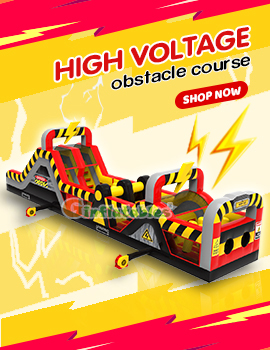
Scale with: Multi-station carnival combos or race tracks once you have the client relationships and event scale to justify the footprint. At this stage, you may also want to evaluate obstacle courses as a parallel fleet expansion — they share a similar event profile and attract the same corporate and school-event clients.
Buying a large inflatable games setup before you've validated the market's event profile is the most common ROI mistake rental operators make with interactive game inventory.
Seasonal Utilization Planning
Interactive games have a strong Q2–Q3 outdoor event peak. Unlike bounce houses, which have year-round indoor event options, large arena and race-track configurations are harder to deploy indoors. For operators in seasonal markets, this compresses the payback window.
Calculate your realistic booking weeks — not the theoretical maximum. If your outdoor season runs 24 weeks and you project 60% utilization, you have roughly 14 bookable weeks to cover your ownership cost. Work backwards from that figure to determine what rental rate you need, and whether the purchase price makes sense at current market rates. The same utilization logic applies when evaluating inflatable obstacle courses — the market overlap between obstacle and game events is significant.
Sourcing and Lead Time Considerations
When evaluating inflatable games for sale, lead time is an underappreciated variable. Custom-configured units from manufacturers can run 30–60 days from order to delivery, sometimes longer for large multi-station setups. If you're targeting spring deployment, orders placed after February create scheduling risk.
Standard units held in-stock by distributors carry shorter lead times but less flexibility on configuration. For most rental operators, a mix of catalog units (fast deployment) and one or two configured specialty pieces works better than building your entire game inventory custom.
Ginflatables carries 250+ commercial-grade interactive game configurations — from compact skill stations to large arena units — with direct factory pricing and flexible lead times for rental fleet orders.
Ready to Add This to Your Fleet?
Ginflatables builds commercial-grade inflatables to spec for rental operators and event businesses.