
Inflatables
Inflatable Obstacle Course Buying Guide: What Event Planners and Rental Operators Need to Know
What Makes a Commercial-Grade Inflatable Obstacle Course
A commercial inflatable obstacle course isn't the same product you'd find at a big-box toy store. Commercial units are built for repeated daily use by adult-weight participants, outdoor deployment on rough terrain, and transport across dozens of events each season. If you're running a rental fleet, hosting large-scale corporate events, or operating a family entertainment center, the unit needs to hold up under that load—and deliver a reliable experience every time.
The main differentiators between commercial and residential obstacle courses come down to material gauge, seam construction, blower compatibility, and anchor systems. Commercial PVC is typically 0.55mm to 0.9mm thick, double-stitched with reinforced stress points at climbing walls, tunnel exits, and slide banks. Residential units often use 0.35mm Oxford cloth or thinner PVC with single-stitched seams—fine for occasional backyard use, not for rental rotation.
If you're sourcing an inflatable obstacle course for commercial deployment, always ask the supplier for material specs in writing. "Commercial grade" is used loosely by some manufacturers.
Size Ranges and Setup Requirements
Inflatable obstacle courses typically run from 30 feet to over 100 feet long. Common configurations for rental operators:
- 30–40 ft: Entry-level courses for small events, birthday parties, and school fairs. Weight capacity around 600–800 lbs. Setup requires a 35×15 ft footprint minimum.
- 50–65 ft: Mid-range units suitable for corporate team-building events and festivals. These usually include 4–6 obstacles (crawl tunnels, climbing walls, pop-up bumpers, slide exits). Footprint: 70×18 ft minimum.
- 80–100+ ft: Competition-grade courses used at large festivals, amusement parks, and military/corporate challenge events. Dual-lane versions allow head-to-head racing. Footprint can exceed 110×22 ft.
Always verify ceiling height clearance for indoor deployments. Most obstacle courses peak at 10–14 ft; some dual-lane competition units reach 16 ft at the climbing wall section.
Power requirements: a standard 50–65 ft obstacle course runs on a 1.5 HP continuous-duty blower. Units over 80 ft typically need a 2 HP blower, and some require two separate blowers. Confirm the blower specification before committing to an event venue—especially for indoor spaces with limited generator access.
Single-Lane vs. Dual-Lane: Which Configuration Fits Your Events?
Single-lane courses move participants sequentially. They work well for most birthday events, school field days, and community festivals. Throughput depends on course length: a 50 ft course typically processes 8–12 participants per hour if participants clear it in 3–5 minutes.
Dual-lane courses run two participants simultaneously in parallel lanes—useful for competitive events and team-building where head-to-head racing is part of the experience. Dual-lane units are wider (typically 16–22 ft), heavier, and cost more to ship. They're overkill for small birthday events but command premium pricing at corporate and military events.
For most rental operators building their first blow up obstacle course fleet, a 50–65 ft single-lane unit with 4–5 obstacles hits the best balance between versatility, setup time, and rental income potential.
Material and Construction: What to Check Before You Buy
PVC (polyvinyl chloride) is the standard material for commercial obstacle courses in high-use rental environments. Key specs to request:
- PVC thickness: 0.55mm minimum for commercial use; 0.9mm for heavy-traffic units
- Seam type: Double-stitched with PVC weld or heat-seal reinforcement at stress points
- Mesh panels: Should be rip-stop nylon or reinforced PVC mesh (not thin fabric) for ventilation and visibility
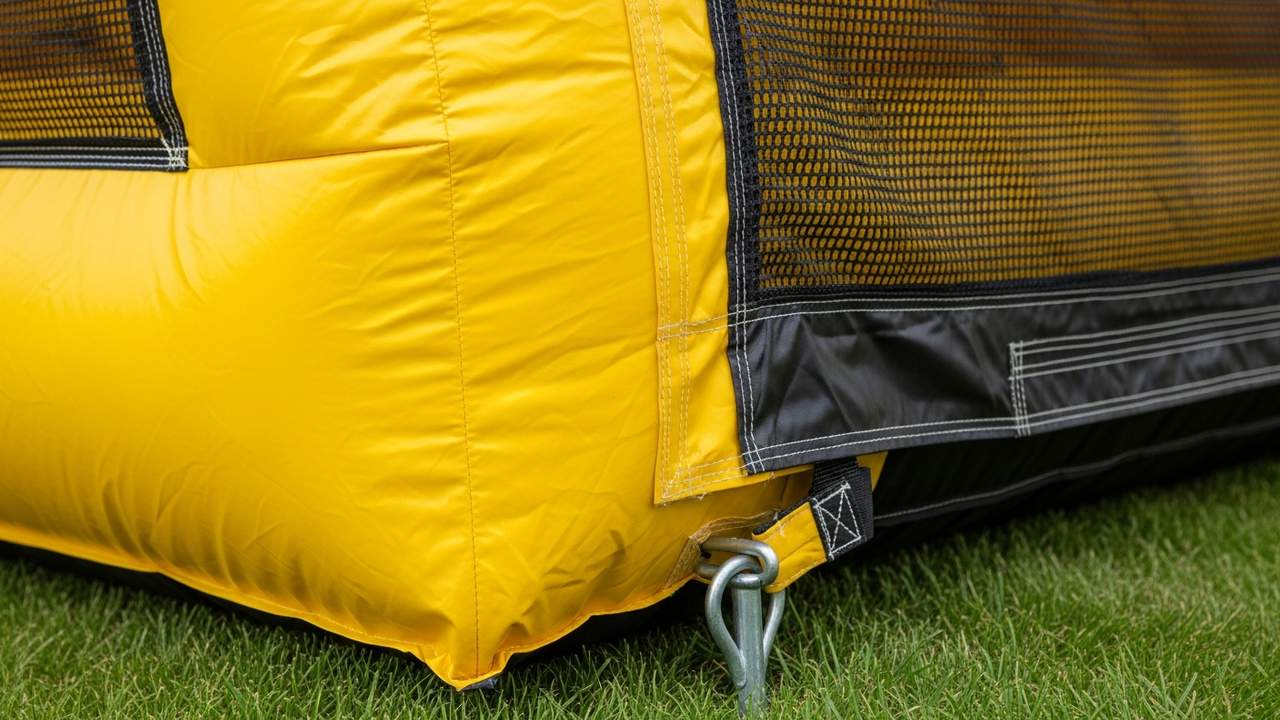
- Anchor D-rings: Minimum 6 ground anchor points on a 50 ft course; 8–10 on units over 80 ft
Oxford cloth (600D Oxford polyester) is sometimes marketed as a commercial alternative. It's lighter, which makes setup faster and shipping costs lower. However, Oxford cloth has lower UV and abrasion resistance than commercial PVC, and seam integrity degrades faster under heavy rotation. For operators running 3+ events per week, commercial PVC is the right call despite the higher upfront cost. For lower-frequency operators (weekend-only deployments), Oxford cloth in the 600D range is acceptable.
Check whether the unit includes repair kit patches in the same material as the main body. Some manufacturers ship mismatched patch materials—which matters when you need a fast field repair at an event site.
Price Range and ROI for Rental Businesses
Commercial inflatable obstacle courses typically range from $1,200 to $6,500+ depending on size, material spec, and configuration. Rough benchmarks:
- 30–40 ft single-lane PVC: $1,200–$2,200
- 50–65 ft single-lane commercial PVC: $2,500–$3,800
- 80 ft+ competition or dual-lane: $4,000–$7,000+
Rental pricing for obstacle courses typically runs $350–$800 per event for mid-range units, depending on your market and delivery radius. A $3,000 unit rented at $400/event breaks even in 7–8 bookings—most operators recover cost within a single season if the unit is actively marketed.
Factor in: blower cost ($150–$400 if not included), transport (obstacle courses are bulky—verify packing dimensions and bag weight before ordering), and replacement parts budget (~5–8% of unit cost annually).
Operators who pair obstacle courses with inflatable bouncers and combo units report higher average event ticket values, since customers often bundle multiple inflatables for larger events. If you're scaling a fleet from scratch, see the bounce house rental business guide for a full breakdown of fleet sizing, insurance, and pricing strategy.
Safety Certifications and Insurance Considerations
In the US, commercial inflatable manufacturers are expected to meet ASTM F2374 (Standard Practice for Classification, Design, Manufacture, Construction and Operation of Inflatable Amusement Devices). Units sold in California must also comply with California SB 1765 requirements. Ask your supplier to confirm which standards the unit is certified against—and get the documentation in writing before purchase.
From an insurance standpoint, most commercial general liability policies for inflatable rental businesses require that units carry documented ASTM compliance. Running uncertified units can void coverage in the event of an injury claim. If you're unsure how to verify a unit's certification status, review the safety precautions guide for inflatable obstacle courses for a full compliance checklist.
Operator-side safety requirements: trained spotters at climbing sections, participant weight and age limits posted visibly at entry, wind speed monitoring (most manufacturers recommend grounding units in winds over 25 mph), and daily pre-event inspection logs.
Shipping, Lead Times, and Supplier Selection
Most commercial obstacle courses are manufactured in China and shipped via sea freight (LCL or FCL). Lead times from order confirmation to delivery typically run 25–45 days for standard units. Custom-color or custom-graphic units can run 45–60 days. Air freight is available for urgent orders but adds $800–$1,500+ depending on weight.
Packing size matters: a 50 ft obstacle course typically packs to a 4×3×2 ft bag at 120–160 lbs. Two-person setup is standard at that size. Units over 80 ft may pack into multiple bags and require a truck with a liftgate for delivery.
When evaluating suppliers, request:
- Pre-shipment inspection report or factory QC photos
- Warranty terms in writing (standard is 1 year on seams, 6 months on electronics/blowers)
- Spare parts availability (patches, D-rings, anchor stakes)
- Reference contacts or order history documentation
Operators scaling a rental fleet should also consider water slide combos and inflatable water slides as complementary products—summer event demand for water units overlaps directly with obstacle course customers.
Frequently Asked Questions
How long does it take to set up a commercial inflatable obstacle course?
A 50–65 ft single-lane course takes 2 people approximately 20–30 minutes to unpack, inflate, and anchor. Larger units (80 ft+) typically require 3 people and 35–50 minutes. Setup time is a real operational cost—factor it into your pricing and scheduling.
Can inflatable obstacle courses be used indoors?
Yes, provided the venue has sufficient ceiling clearance (typically 14–16 ft minimum at the tallest obstacle section), adequate power outlets for blowers, and a smooth floor surface (gymnasium floors, convention halls, warehouse spaces all work). Confirm blower power draw before booking—some venues have strict amperage limits on indoor event equipment.
What's the weight capacity of a typical commercial obstacle course?
Weight capacity depends on the unit's design and number of simultaneous participants allowed. Most 50 ft commercial obstacle courses support 800–1,200 lbs of total distributed load, with operator guidelines of 6–10 participants on the course at a time. Always follow the manufacturer's stated capacity limit—exceeding it voids warranty and creates liability exposure.
How do I maintain an inflatable obstacle course between events?
Wipe down with a mild soap solution after each event, inspect seams and mesh panels for damage, dry completely before packing (folding wet PVC encourages mold), and store in a temperature-controlled environment if possible. Monthly inspection of anchor D-rings and blower connections is good practice. Keep a repair kit on-site at every event—small punctures can usually be patched in under 10 minutes with the right PVC adhesive.
Do I need insurance to rent out inflatable obstacle courses?
Yes. Most jurisdictions require commercial general liability insurance for inflatable rental operators, and many event venues require proof of insurance as a condition of booking. Typical coverage for a small inflatable rental fleet runs $1,500–$3,000/year depending on fleet size, revenue, and claim history. Your units should also carry documentation of ASTM F2374 compliance to support your coverage terms.
Matching Course Length and Lane Count to Your Venue and Rider Age
The spec that makes or breaks an obstacle course purchase isn't the number of obstacles, it's whether the footprint fits your actual bookings. Before you look at any model, measure your worst-case setup site, not your best one. A long single-lane course needs a straight, obstruction-free run plus safety clearance at the entry and exit, and most inflatables want a few feet of margin on every side for stakes or ballast. If your typical gigs are backyard birthdays and tight community-hall lawns, a compact course that folds into an L or U shape will book far more often than a straight run you can only deploy in an open field.
Lane count is a throughput and competition decision. Single-lane courses are cheaper, lighter, and easier for one person to set up, and they suit younger riders and smaller crowds. Dual-lane racing courses cost more and demand more space and crew, but they double the fun factor for schools, corporate field days, and any event where a head-to-head race is the selling point. If your revenue comes from high-attendance events, the second lane pays for itself in booking premium and repeat demand; if you're a weekend party operator, it's often dead weight.
Rider age dictates obstacle height and passage width more than overall length. Courses aimed at young children use lower climbs, gentler slides, and wider crawl-throughs, while teen and adult courses run taller walls, tighter squeezes, and steeper climbs that smaller kids physically can't clear. Buy for the age group you actually serve most weekends. A course pitched too old alienates the birthday-party market; one pitched too young loses the corporate and school bookings that carry the higher rates.
Ready to Add This to Your Fleet?
Ginflatables builds commercial-grade inflatables to spec for rental operators and event businesses.