
Inflatables
White Bounce House for Sale: Commercial Buying Guide
A white bounce house can suit an event's visual brief while still being the wrong unit for its users, site or turnaround schedule. For a rental company, the buying decision needs both parts: the appearance the client expects and an inflatable the business can supply, operate and maintain under its actual instructions.
This commercial buying guide focuses on those checks. Colour alone does not establish a model's capacity, permitted age range, material specification or suitability for adults at a wedding. Begin with the proposed unit and the bookings you can substantiate, rather than a claim that white equipment automatically earns a premium.
Choose the Configuration Before Approving the Look
Decide what the booking actually requires: a bouncing attraction, a particular themed shape or several play activities in one unit. A photograph taken at a wedding does not establish that the pictured equipment is approved for adult use. Likewise, a white surface does not make two different models operationally interchangeable.
Compare the commercial bouncer range for a bouncing-focused brief. If the enquiry includes a slide or other activity, review the bounce house combo models separately and confirm which features belong to the selected unit. Do not infer a pool, hoop or detachable component from another product's image.
Ask for the model reference and current drawing with the quotation. Record the intended users and the event's purpose explicitly. A supplier needs to distinguish a children's play area from a request involving adult participants; the intended use should not remain hidden behind the word “wedding.”
Define What “White” Means in the Order
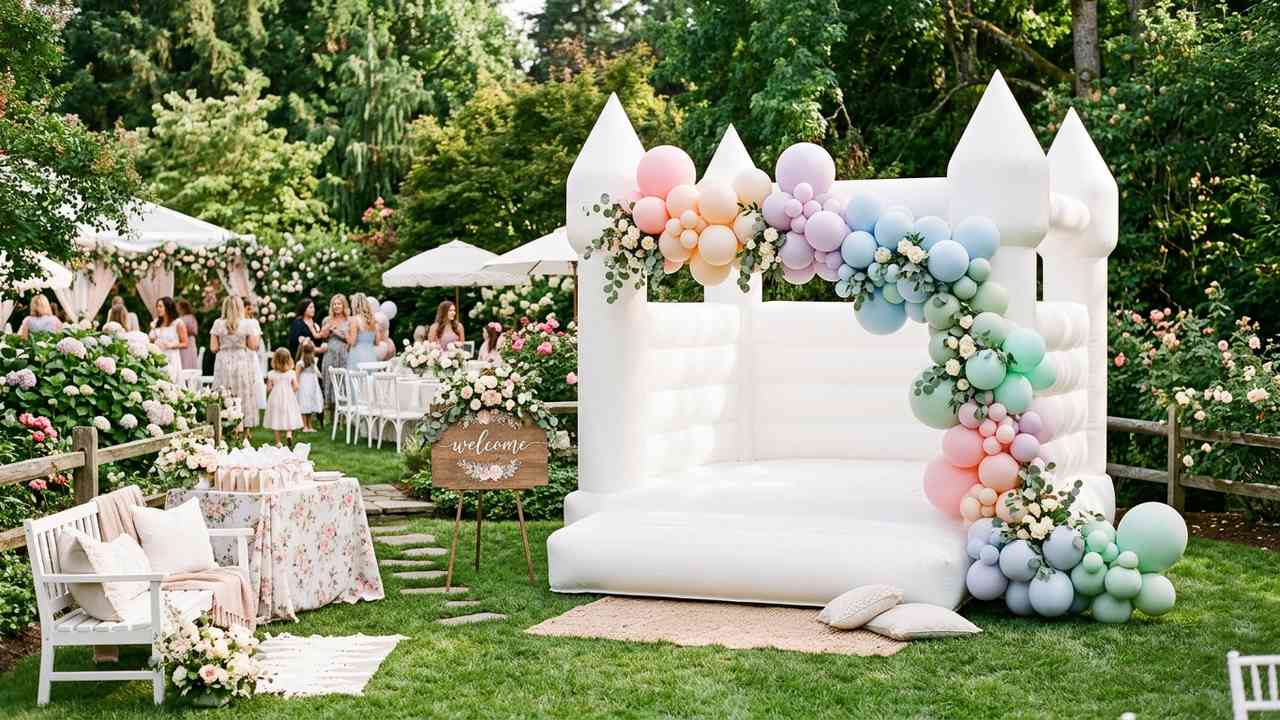
Specify which visible surfaces should be white and which colours or components may differ. Discuss the walls, roof, base, entrance and any attached activity area using the actual drawing. A darker underside, contrasting reinforcement or differently coloured connection can matter to a client's proposed photographs even when it is outside the main front view.
Request representative images and, where appropriate, an agreed material sample. Review the proposed finish under the lighting relevant to the booking. A screen image is useful for discussing appearance, but it cannot establish the physical finish or how every camera will render it.
Keep logos, artwork and proposed styling visible in the approval conversation. Obtain the manufacturer's agreement for any decoration method and the event team's approval for its location. Do not assume adhesive graphics, lighting or balloon attachments are supported simply because similar styling appears in a promotional photograph.
Check the Whole Operating Space
Compare the model drawing with the measured venue, including the entrance route and the areas needed for its actual installation. A listed length and width describe the unit; they are not a complete site plan. Doorways, ceiling obstructions, access for handling and the permitted installation surface can rule out an otherwise attractive option.
Use the bounce house dimensions and site-fit guide for the broader space discussion. Have the responsible supplier or operator confirm the selected model's requirements rather than applying a standard clearance or blower size to every white bouncer.
For a venue proposal, retain the drawing version used to make the comparison. If a different model is later offered, review that layout again. A substitute with a similar front silhouette can have a different entrance, connection position or activity arrangement.
Separate Appearance from Rider Limits
Obtain the applicable operating instructions and user limits for the actual model. The rider-limit and capacity guide explains why individual limits and simultaneous use need their own evidence. Do not calculate permitted users from the floor area or describe a unit as adult-rated without the relevant confirmation.
Ask which operating, inspection and supporting equipment information will accompany the supply. For UK projects within its scope, HSE's play-inflatable guidance provides checks concerning operating instructions and use. It is not evidence that a particular catalogue model carries every certification mentioned elsewhere online.
Agree Care Instructions Before Estimating Turnaround
Request cleaning and drying instructions for the quoted material and finish, including any restrictions on products, tools or decorative treatments. Do not assume that a household abrasive sponge or a cleaner recommended for another fabric is appropriate for this unit.
Plan how the crew will inspect visible marks and establish whether the appearance meets the next booking's agreed expectations. Keep cosmetic observations separate from equipment inspection: a mark may need explanation or treatment, while an apparently clean surface does not establish operating condition.
Use your own handling and care records to estimate turnaround. Include the time actually needed to clean, dry, check and pack the selected equipment under its instructions. Avoid promising a fixed cleaning allowance, stain-proof finish or number of rental seasons before that evidence exists.
Build the Purchase Decision from Real Enquiries
Review requests your business has received for white equipment, the required configurations and the dates you could realistically fulfil. Distinguish an enquiry from an accepted booking. Compare the proposed addition with equipment you already own before assuming it creates incremental revenue.
A useful quotation identifies the exact model, agreed appearance, included components, relevant instructions, packed dimensions and weight, delivery terms and current availability. Keep optional styling and separately sourced items identifiable. The result should be a unit your team can describe accurately to clients, with an appearance and operating arrangement that match what was actually agreed.
Ready to Add This to Your Fleet?
Ginflatables builds commercial-grade inflatables to spec for rental operators and event businesses.