
Inflatables
Bounce House Size Guide: How to Match Unit Size to Event Type
Ordering the wrong size bounce house wastes money in both directions. Too small and you're turning away bookings for larger events. Too large and you can't fit the unit in standard backyards — which is where 70% of rental bookings happen.
This guide covers every commercial bounce house size category, what events each one fits, space requirements, weight specs, and crew needs. Use it to build a fleet that covers your market without redundant inventory.
Size Categories at a Glance
| Size | Bounce Area | Capacity | Weight | Best For |
|---|---|---|---|---|
| 10×10 ft | ~80 sq ft | 4–5 kids | 120–160 lbs | Toddler parties, small yards |
| 13×13 ft | ~140 sq ft | 6–8 kids | 180–240 lbs | Standard birthday parties |
| 15×15 ft | ~190 sq ft | 8–10 kids | 250–350 lbs | Most rental bookings (the workhorse) |
| 18×18 ft | ~270 sq ft | 10–14 kids | 350–450 lbs | Large parties, school events |
| 20×20 ft | ~340 sq ft | 14–18 kids | 400–550 lbs | Festivals, carnivals, corporate |
Note: "capacity" means simultaneous riders within the manufacturer's weight limit. Actual throughput at events is higher because kids rotate in and out.
10×10 and 13×13: The Compact Units
These are your toddler and small-party units. A 10×10 fits in almost any backyard and is light enough for a single-person setup. A 13×13 is the smallest size most operators consider truly "commercial" — it handles a standard birthday party of 6–8 kids without feeling cramped.
Space requirement. Add 3–4 feet on every side for anchoring and safe entry/exit. A 13×13 unit needs a flat, clear area of roughly 19×19 ft minimum.
Transport. Both sizes fit in an SUV or minivan when deflated and rolled. Weight under 250 lbs means one person can handle delivery in most cases, though a hand truck helps.
Limitations. These units don't handle mixed-age groups well. If older kids (8+) are jumping alongside toddlers, the size differential creates safety issues. For events with mixed ages, recommend a 15×15 or larger to the client.
15×15: The Fleet Workhorse
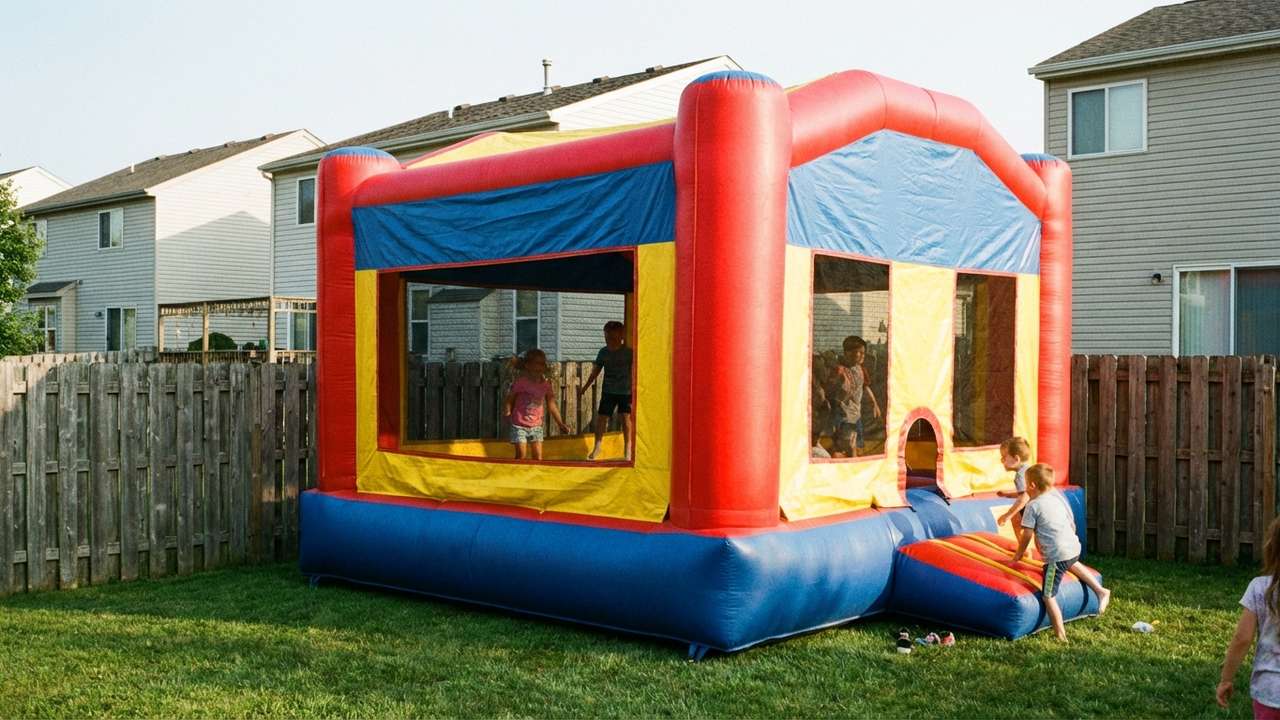
If you only own one commercial bounce house, it should be a 15×15. This size handles the widest range of bookings:
- Standard backyard birthday parties (the bulk of residential rentals)
- Church and community events (paired with other activities)
- Corporate family days (as one of several attractions)
- School fun days and PTA fundraisers
Space requirement. A 15×15 needs a flat area of at least 21×21 ft (unit + perimeter clearance). This fits comfortably in most suburban backyards. Always confirm with the client — a "big backyard" in their mind might be 18×20 ft in reality.
Weight and crew. At 250–350 lbs packed, a 15×15 requires two people for safe loading and unloading. Setup takes 15–20 minutes including inflation, anchoring, and safety check. One commercial 1.5 HP blower handles this size.
Why it's the standard. The 15×15 hits the sweet spot of capacity, transportability, and venue compatibility. Operators who start with this size report the fewest booking-to-venue mismatches.
18×18 and 20×20: The Large-Event Units
These sizes serve events where a 15×15 would feel undersized — school carnivals, festival midways, large church gatherings, and corporate events expecting 50+ attendees.
Space requirement. An 18×18 needs roughly 24×24 ft clear. A 20×20 needs 26×26 ft minimum. At these dimensions, standard backyards are often too small. Confirm the venue is a park, field, gymnasium, or large commercial property before accepting the booking.
Weight and crew. 350–550 lbs packed means you need a truck or trailer, not an SUV. Setup requires two people minimum, and 20×20 units typically need two blowers running simultaneously. Plan for 25–35 minutes of setup time.
When to add one to your fleet. Don't start here. Large units sit idle more often because fewer venues can accommodate them. Add an 18×18 or 20×20 after you've established steady bookings with 15×15 units and you're regularly turning away requests for larger events.
Combo Units: Size Plus Features
A bounce house combo — bounce area plus slide, climbing wall, or basketball hoop — takes up more footprint than a same-size standalone bouncer. A "15×15 combo" typically measures 15×20 or 15×25 ft overall because the slide extends beyond the bounce area.
Critical sizing note: Always quote the full footprint, not just the bounce area dimensions. A client with a 20×20 backyard can't fit a "15×15 combo" that's actually 15×24 including the slide. This is the #1 cause of day-of-event problems for combo unit rentals.
Combos command higher rental rates than standalone bouncers of equivalent size, because they offer multiple activities in a single unit. But they're also heavier (often 50–100 lbs more) and take longer to set up.
Weight Limits: Per-Rider vs Total Load
Every commercial bounce house has two weight specifications that matter:
Per-rider weight limit. The maximum weight for a single person on the unit. Standard kids' bounce houses rate at 100–150 lbs per rider. Units marketed for older children or adults should rate at 200+ lbs per rider.
Total load capacity. The combined weight of all riders at once. A 15×15 rated for 8 riders at 100 lbs each has a total load capacity of 800 lbs. Exceeding total load stresses the seams, floor, and anchoring system — even if no individual rider exceeds the per-person limit.
For rental operations, communicate both numbers clearly to clients at booking. A common problem: a parent books a unit rated for "8 kids" but expects it to hold 8 twelve-year-olds. The unit might handle 8 five-year-olds at 40 lbs each (320 lbs total) but not 8 twelve-year-olds at 90 lbs each (720 lbs total) if the load capacity is 600 lbs.
Matching Size to Your Market
Your fleet composition should match your booking patterns, not a theoretical ideal. Here's how most successful operators build out:
- Starting fleet (1–2 units): One 15×15 standalone + one 13×13 or 15×15 combo. This covers 80% of standard bookings.
- Growth fleet (3–5 units): Add themed or specialty units (like a castle design) and one 18×18 for larger events.
- Established fleet (6+ units): Mix in water combos, obstacle courses, and niche units. At this scale, you need variety more than additional standard sizes. Explore obstacle courses for the corporate and school segments.
Track which sizes book most frequently in your first season. If 15×15 units book every weekend and your 13×13 sits idle, your market is telling you something. Let booking data drive your next purchase, not assumptions about what you think clients want.
For sizing the youngest guests, see the complete toddler bounce house buyer guide.
Ready to Add This to Your Fleet?
Ginflatables builds commercial bounce houses to commercial-grade specs for rental operators and event businesses.
Get a QuoteWhatsApp